
• Youtube Icon
  • Twitter icon
  • Instagram icon
  • LinkedIn icon
  • Facebook icon
Logo
    • Who we are
      • Who we are
      • Where we work
      • Who we work with
      • How we work
      • Our people
      • Our values
      • Genesis in the community
      • Our history
    • What we do
      • Behavioural solutions
      • Climate Finance and Economics
        • Climate finance
        • Just transition
        • Resilience and adaptation
      • Competition and Regulatory Economics
        • Competition economics
        • Regulatory economics
        • Communication and broadcasting
        • Damages and other litigation
        • Energy
        • Trade
      • Economic opportunity
        • Agriculture and agribusiness
        • MSME development
        • Gender and development
        • Green economy
        • Youth
      • Financial Services Strategy
        • Financial sector strategy
        • Market analysis and positioning
        • Financial risk management
        • Financial market policy
        • Financial inclusion
        • Applied behavioural economics
        • Payments
        • Digital financial services
        • Strategic due diligence
        • Partnerships
      • Frontier Technologies
        • Digital opportunities and their enablers
        • Digital public infrastructure
        • Digital policy and regulation
        • The Goat Framework
      • Health
        • Reproductive, maternal, child health and nutrition
        • Infectious diseases and pandemic preparedness
        • Digital health and data transformation
        • Health financing and systems optimisation
      • Human Development
        • Education
        • Social protection, child protection and jobs
        • Social sectors financing
        • Public finance management
      • Monitoring, evaluation and learning
        • Programme and impact evaluation
        • Monitoring and results measurement
        • Integrated monitoring, evaluation and learning
      • Primary Data Intelligence (PDI)
      • Economic Growth and Impact
        • Corporate impact and ESG
        • Political and public policy advisory for corporates
        • Economic and regulatory impact assessments
        • Just transition
        • Digital livelihoods
      • Services
        • Genesis Global Business Services
    • Our purpose
    • Join our team
      • Join our team
      • Why I chose Genesis
      • Young professionals
      • Experienced hires
      • Sign up to be an independent consultant
      • Bursaries
      • Our internship programme
    • News and insights
      • News
      • Newsletters
      • Reports and other documents
    • Contact us
      • Business Development Unit
      • Corporate enquiries
      • Careers
      • Offices
    • Who we are
      • Who we are
      • Where we work
      • Who we work with
      • How we work
      • Our people
      • Our values
      • Genesis in the community
      • Our history
    • What we do
      • Behavioural solutions
      • Climate Finance and Economics
        • Climate finance
        • Just transition
        • Resilience and adaptation
      • Competition and Regulatory Economics
        • Competition economics
        • Regulatory economics
        • Communication and broadcasting
        • Damages and other litigation
        • Energy
        • Trade
      • Economic opportunity
        • Agriculture and agribusiness
        • MSME development
        • Gender and development
        • Green economy
        • Youth
      • Financial Services Strategy
        • Financial sector strategy
        • Market analysis and positioning
        • Financial risk management
        • Financial market policy
        • Financial inclusion
        • Applied behavioural economics
        • Payments
        • Digital financial services
        • Strategic due diligence
        • Partnerships
      • Frontier Technologies
        • Digital opportunities and their enablers
        • Digital public infrastructure
        • Digital policy and regulation
        • The Goat Framework
      • Health
        • Reproductive, maternal, child health and nutrition
        • Infectious diseases and pandemic preparedness
        • Digital health and data transformation
        • Health financing and systems optimisation
      • Human Development
        • Education
        • Social protection, child protection and jobs
        • Social sectors financing
        • Public finance management
      • Monitoring, evaluation and learning
        • Programme and impact evaluation
        • Monitoring and results measurement
        • Integrated monitoring, evaluation and learning
      • Primary Data Intelligence (PDI)
      • Economic Growth and Impact
        • Corporate impact and ESG
        • Political and public policy advisory for corporates
        • Economic and regulatory impact assessments
        • Just transition
        • Digital livelihoods
      • Services
        • Genesis Global Business Services
    • Our purpose
    • Join our team
      • Join our team
      • Why I chose Genesis
      • Young professionals
      • Experienced hires
      • Sign up to be an independent consultant
      • Bursaries
      • Our internship programme
    • News and insights
      • News
      • Newsletters
      • Reports and other documents
    • Contact us
      • Business Development Unit
      • Corporate enquiries
      • Careers
      • Offices
  • Youtube icon
  • Twitter icon
  • Instagram icon
  • Linked In Icon
  • Facebook icon
image

Genesis launches two new ways to view the COVID-19 epidemic

26 May 2020

COVID-19

Genesis Analytics has launched two important and useful new tools for looking at and understanding the Covid-19 epidemic. This comes amid daily predictions and models that tell us how severely the Covid-19 epidemic will become in South Africa, as well as the rest of the continent. These models are important planning tools, but they have limitations.

Models are always a best-guess prediction, and for Covid-19 all models have shown a limited ability to predict the course of epidemics around the world. This is not surprising because this is a new virus and there is a lot we do not understand yet about how it spreads in communities. Our actions in containing the epidemic will also determine the extent of its spread.

For all of these reasons, we are presenting two new ways of viewing the epidemic, as it is now. We think these will be helpful for anyone trying to answer two important questions:

1. Are our health services about to become overwhelmed?

2. How are the different provincial epidemics in South Africa evolving, especially with the likely loosening of restrictions on economic activity?

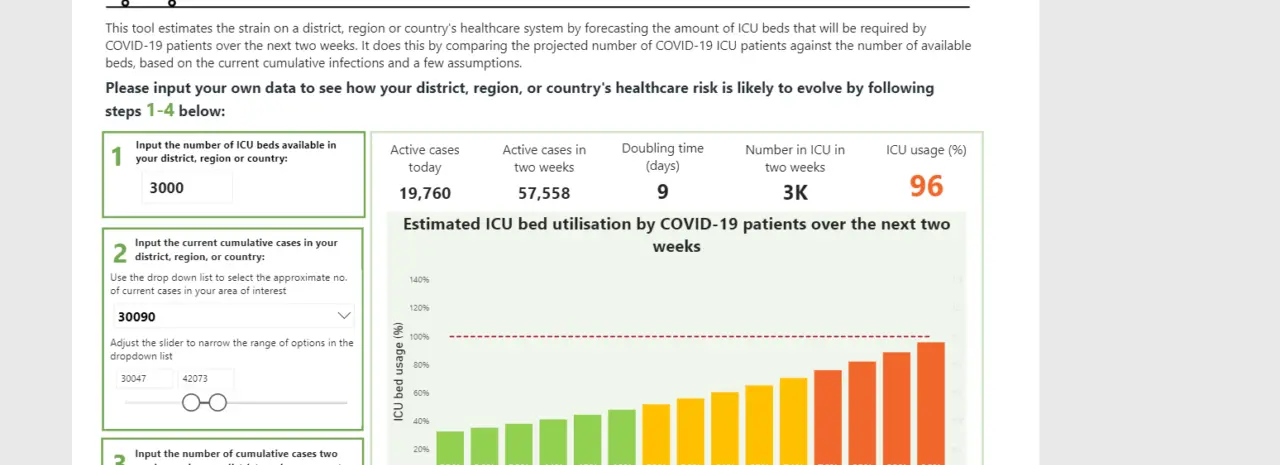
To answer the first question, we have developed a Covid-19 Calculator. This can be found here. The calculator predicts your need for ICU or critical-care beds for the next two weeks, based on the number of cases in an area over the last two weeks, and the number of beds available. At a time when many routine surgeries are being cancelled because of fears of health systems being overwhelmed, this calculator can be a useful tool for understanding the likely short-term strain on health services. Try it out and let us know what you think.

South Africa, like many countries, is experiencing very different epidemics in different locations. It is helpful to think of the types of Covid-19 epidemics in three ways:

1. Sporadic cases, often imported from outside the area, with limited or no local or community transmission.

2. Clusters or outbreaks. These are in locations where people live or work closely together – hospitals, prisons, care homes, religious ceremonies, certain workplaces, etc. We have seen a number of these occur in South Africa that can either spread or be contained.

3. Sustained community transmission. This is what we are trying to avoid.

It is unhelpful to continue to report on the total number of cases in an area, because this does not tell us much about how the epidemic is evolving. You need to measure either active, or new, cases and the rate at which these are increasing or decreasing. This is what we are reporting for each South African province here.

As we already know, the Western Cape, and to a lesser extent the Eastern Cape, are experiencing sustained community transmission. The other provinces at this stage are either seeing cluster outbreaks, or sporadic cases. This is likely to change and we need to continue to track these trends closely.

How this epidemic evolves is up to all of us:

  • Keep practising physical distancing and good hand hygiene, and wear a cloth mask when in public.
  • Keep employees safe in the workplace.
  • Health services need to continue to test, trace contacts and isolate.
  • We need to protect our health workers and vulnerable people in the population.

This article was published on LinkedIn on 26 May 2020

Share Article

Back to news

IMPACT UNLOCKED.

Subscribe now to our monthly newsletter.

© 2026. All rights reserved.

  • Youtube Icon
  • Twitter icon
  • Instagram icon
  • LinkedIn icon
  • Facebook icon
  • Privacy Policy
  • Email Disclaimer
  • Whistle-Blowing Form

Head Office:
50 6th Road, Hyde Park, Johannesburg, 2196

Switchboard:
+27 (0)11 9947 000

Facsimile:
086 688 2247

We value your privacy

We use cookies to enhance your browsing experience and analyse our traffic. Analytics cookies are on by default; you can switch them off here at any time. By clicking "Accept All", you also consent to marketing cookies.

View Cookie Policy
Subscribe now to our monthly newsletter.

IMPACT UNLOCKED.

Sharp analysis.
Lasting solutions.

Subscribe now to our monthly newsletter.