
• Youtube Icon
  • Twitter icon
  • Instagram icon
  • LinkedIn icon
  • Facebook icon
Logo
    • Who we are
      • Who we are
      • Where we work
      • Who we work with
      • How we work
      • Our people
      • Our values
      • Genesis in the community
      • Our history
    • What we do
      • Behavioural solutions
      • Climate Finance and Economics
        • Climate finance
        • Just transition
        • Resilience and adaptation
      • Competition and Regulatory Economics
        • Competition economics
        • Regulatory economics
        • Communication and broadcasting
        • Damages and other litigation
        • Energy
        • Trade
      • Economic opportunity
        • Agriculture and agribusiness
        • MSME development
        • Gender and development
        • Green economy
        • Youth
      • Financial Services Strategy
        • Financial sector strategy
        • Market analysis and positioning
        • Financial risk management
        • Financial market policy
        • Financial inclusion
        • Applied behavioural economics
        • Payments
        • Digital financial services
        • Strategic due diligence
        • Partnerships
      • Frontier Technologies
        • Digital opportunities and their enablers
        • Digital public infrastructure
        • Digital policy and regulation
        • The Goat Framework
      • Health
        • Reproductive, maternal, child health and nutrition
        • Infectious diseases and pandemic preparedness
        • Digital health and data transformation
        • Health financing and systems optimisation
      • Human Development
        • Education
        • Social protection, child protection and jobs
        • Social sectors financing
        • Public finance management
      • Monitoring, evaluation and learning
        • Programme and impact evaluation
        • Monitoring and results measurement
        • Integrated monitoring, evaluation and learning
      • Primary Data Intelligence (PDI)
      • Economic Growth and Impact
        • Corporate impact and ESG
        • Political and public policy advisory for corporates
        • Economic and regulatory impact assessments
        • Just transition
        • Digital livelihoods
      • Services
        • Genesis Global Business Services
    • Our purpose
    • Join our team
      • Join our team
      • Why I chose Genesis
      • Young professionals
      • Experienced hires
      • Sign up to be an independent consultant
      • Bursaries
      • Our internship programme
    • News and insights
      • News
      • Newsletters
      • Reports and other documents
    • Contact us
      • Business Development Unit
      • Corporate enquiries
      • Careers
      • Offices
    • Who we are
      • Who we are
      • Where we work
      • Who we work with
      • How we work
      • Our people
      • Our values
      • Genesis in the community
      • Our history
    • What we do
      • Behavioural solutions
      • Climate Finance and Economics
        • Climate finance
        • Just transition
        • Resilience and adaptation
      • Competition and Regulatory Economics
        • Competition economics
        • Regulatory economics
        • Communication and broadcasting
        • Damages and other litigation
        • Energy
        • Trade
      • Economic opportunity
        • Agriculture and agribusiness
        • MSME development
        • Gender and development
        • Green economy
        • Youth
      • Financial Services Strategy
        • Financial sector strategy
        • Market analysis and positioning
        • Financial risk management
        • Financial market policy
        • Financial inclusion
        • Applied behavioural economics
        • Payments
        • Digital financial services
        • Strategic due diligence
        • Partnerships
      • Frontier Technologies
        • Digital opportunities and their enablers
        • Digital public infrastructure
        • Digital policy and regulation
        • The Goat Framework
      • Health
        • Reproductive, maternal, child health and nutrition
        • Infectious diseases and pandemic preparedness
        • Digital health and data transformation
        • Health financing and systems optimisation
      • Human Development
        • Education
        • Social protection, child protection and jobs
        • Social sectors financing
        • Public finance management
      • Monitoring, evaluation and learning
        • Programme and impact evaluation
        • Monitoring and results measurement
        • Integrated monitoring, evaluation and learning
      • Primary Data Intelligence (PDI)
      • Economic Growth and Impact
        • Corporate impact and ESG
        • Political and public policy advisory for corporates
        • Economic and regulatory impact assessments
        • Just transition
        • Digital livelihoods
      • Services
        • Genesis Global Business Services
    • Our purpose
    • Join our team
      • Join our team
      • Why I chose Genesis
      • Young professionals
      • Experienced hires
      • Sign up to be an independent consultant
      • Bursaries
      • Our internship programme
    • News and insights
      • News
      • Newsletters
      • Reports and other documents
    • Contact us
      • Business Development Unit
      • Corporate enquiries
      • Careers
      • Offices
  • Youtube icon
  • Twitter icon
  • Instagram icon
  • Linked In Icon
  • Facebook icon
image

Potential impact of Google's subsea Africa cable

  • Focus Area:

    Economic impact assessment
    Digital opportunity and their enablers

  • Client:

    Google

  • Countries:

    Congo Democratic Republic Of The
    Namibia
    Nigeria
    South Africa
    Togo

  • Date:

    2020 - 2022

  • Project name:

    Equiano Economic Impact Analysis

Though internet coverage, and speeds have been on an upward trend and internet penetration continues to grow, 70% of people living in Sub-Saharan Africa in 2020 hardly used the internet, if at all.

Google announced in 2019 it would finance a subsea internet cable, Equiano, running from Portugal to South Africa along the Atlantic Coast of Africa. The cable has a design capacity of 144 Tbps, the largest of any installed submarine cables on the African continent. 

Equiano has four confirmed branches that will land in Lomé, the capital of Togo, in Lagos, Nigeria, at Swakopmund, Namibia, and at the South Atlantic island of St Helena.

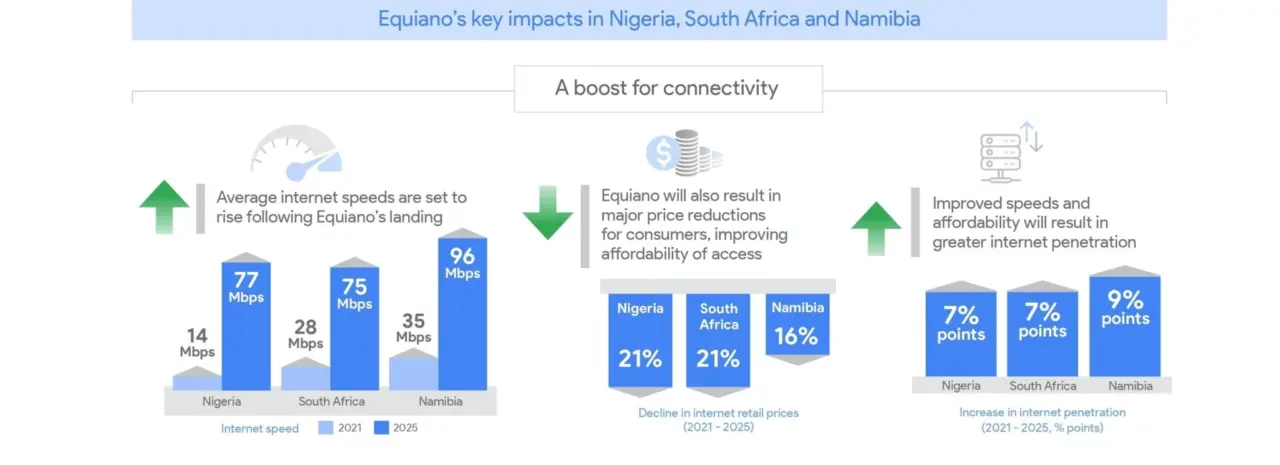
In order to highlight the potential socio-economic impact of this investment and promote the adoption of the cable by the intended partners/clients, Google engaged Genesis through Africa Practice to undertake an impact assessment of the cable in the countries where it would land. 

The Genesis team proceeded to develop an impact pathway that summarised how the installation of the Equiano cable would result in technological, social and economic advances. Measurement of impact was rooted in the quantification of the relationship between variables of the impact pathway. Specifically, the team sought to answer the following questions:

  • How will the installation of the Equiano cable change a country's used international bandwidth/bandwidth capacity?
  • How will a change in a country’s bandwidth capacity change average internet speeds in the country?
  • How will a change in a country’s bandwidth capacity lead to a change in the cost of internet in the country?
  • How will an increase in internet speeds lead to a change in the intensive use of the internet?
  • How will a decrease in the retail price of the internet lead to a change in the intensive and extensive (internet penetration) use of the internet?
  • How will an increase in internet use and penetration lead to a change in economic output?
  • How will an increase in internet use and penetration lead to a change in employment rates?
  • How will an increase in internet use and penetration lead to a change in greenhouse gas emissions?

These questions were answered through a rigorous review of various empirical studies conducted in the last 10 years. These quantified values were then applied to the impact analysis, taking into account the internet landscape of the focus countries in the assessment. This enabled the ultimate quantification of Equiano’s impact on real economic output/growth, employment and greenhouse gas emissions.

A number of the impact assessments have since been published, raising awareness about the cable and its potential impact among government agencies, regulators and other internet service providers.

Publications:

Equiano Subsea Cable: Regional Economic Impact Assessment

Equiano Economic Impact Assessment: Nigeria

Equiano Economic Impact Assessment: Togo

IMPACT UNLOCKED.

Subscribe now to our monthly newsletter.

© 2026. All rights reserved.

  • Youtube Icon
  • Twitter icon
  • Instagram icon
  • LinkedIn icon
  • Facebook icon
  • Privacy Policy
  • Email Disclaimer
  • Whistle-Blowing Form

Head Office:
50 6th Road, Hyde Park, Johannesburg, 2196

Switchboard:
+27 (0)11 9947 000

Facsimile:
086 688 2247

We value your privacy

We use cookies to enhance your browsing experience and analyse our traffic. Analytics cookies are on by default; you can switch them off here at any time. By clicking "Accept All", you also consent to marketing cookies.

View Cookie Policy
Subscribe now to our monthly newsletter.

IMPACT UNLOCKED.

Sharp analysis.
Lasting solutions.

Subscribe now to our monthly newsletter.